Scientist – Rids the World of the Evil Curse of the Vampires (1981)
By Rafi Mercer
Thunder cracks. A bassline lumbers into view, deep and ominous. Then the echoes start: snare hits ricocheting into the distance, synth stabs bouncing like spectral laughter. It is theatrical, cartoonish, and yet deadly serious. This is Scientist – Rids the World of the Evil Curse of the Vampires, released in 1981, one of the most iconic dub records of all time. To this day, it stands as proof that dub is as much imagination as it is rhythm — a genre where the mixing desk becomes stage, laboratory, and haunted house all at once.
Scientist, born Hopeton Brown, was barely in his twenties when he made this record. Trained under King Tubby, he absorbed the master’s techniques but added his own flair: brighter, bolder, more playful. Where Tubby was an engineer-philosopher, Scientist was an engineer-showman. His mixes were not only about space but about drama. He loved theme, spectacle, and narrative, and nowhere is that more obvious than here, in his Halloween-inspired dub suite.
The album is built from rhythms laid down by the Roots Radics, Jamaica’s preeminent backing band of the era. Their grooves are tight, relentless, pared down to bass, drums, and spare guitar. On that foundation, Scientist goes to work. Using reverb, echo, phasing, and EQ, he transforms each track into a new world. The songs bear titles like “Dance of the Vampires,” “The Mummy’s Shroud,” “Your Teeth in My Neck,” “Plague of Zombies.” The effect is both humorous and eerie. You feel as though you are inside a Jamaican sound system haunted by B-movie phantoms.
“Dance of the Vampires” is pure atmosphere: bassline pounding like a heartbeat, hi-hats dissolving into smoke, fragments of guitar and organ darting like shadows. “The Mummy’s Shroud” slows things down, its rhythm heavy and lumbering, echoes stretching into cavernous space. “Your Teeth in My Neck” is sharper, more jagged, with sudden bursts of treble slicing through the mix like fangs. Throughout, Scientist’s hand on the faders is audible — instruments dropping in and out, sounds mutated beyond recognition, silence used as weapon.
What makes this album so compelling is its sense of theatre. Dub had always carried an element of performance, but here Scientist leans into it fully. The horror theme gives him license to exaggerate, to push effects to extremes, to turn the mixing desk into a stage set. And yet, beneath the play, the musicianship is impeccable. The Roots Radics hold the grooves steady, allowing Scientist to stretch them without breaking. The result is music that is both humorous and hypnotic, playful and profound.
For listeners new to dub, Rids the World of the Evil Curse of the Vampires is a perfect entry point. Its themes are familiar, its atmosphere cinematic, its grooves irresistible. You do not need to know the intricacies of reggae history to enjoy it. You can approach it as horror soundtrack, as experimental electronic, as bass-heavy party music. Its inclusivity lies in its accessibility: it entertains even as it innovates.
Culturally, the album has become legendary. It was released during dub’s peak, but its reputation has only grown. Collectors prize it, DJs still spin it, and its influence can be traced into hip-hop, drum and bass, dubstep, and beyond. It showed that dub could be concept album, spectacle, story — not only stripped-down version but expansive world.
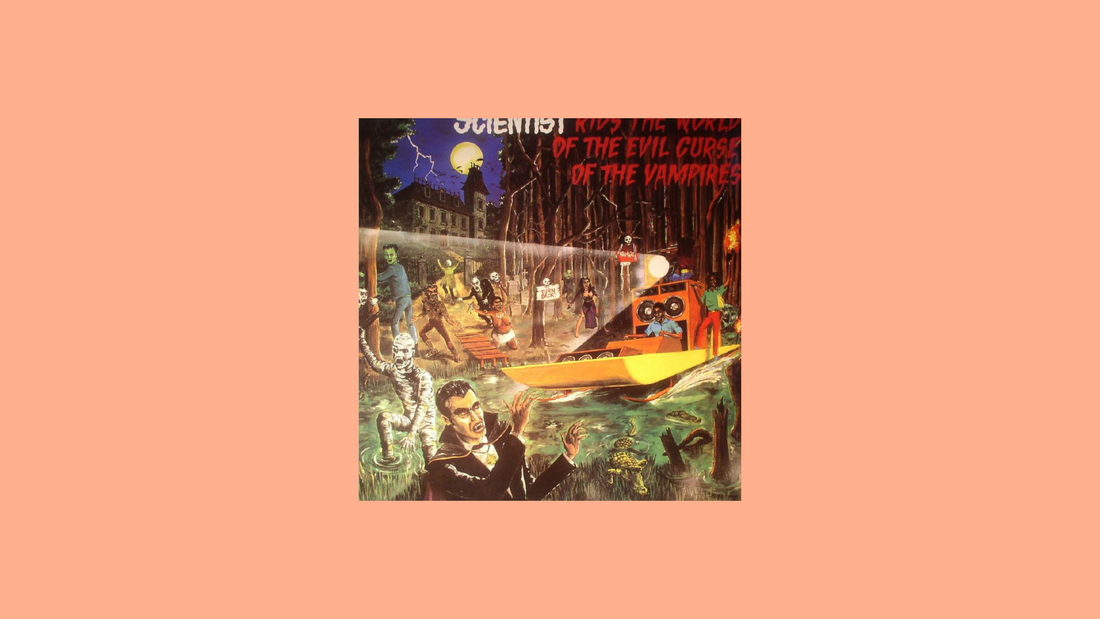
On vinyl, the record is especially alive. The bass is physical, vibrating through floorboards. The echoes swirl around the room, the crackle of the pressing merging with Scientist’s effects until the boundary between playback and performance dissolves. The artwork — a lurid cartoon of vampires and coffins — mirrors the music perfectly: colourful, exaggerated, but with teeth.
Scientist was often underestimated in his time, dismissed as a technician rather than an artist. But listening to this record, the artistry is undeniable. He is painting with sound, sculpting with silence, storytelling with echo. He is proving that dub is not only about rhythm but about imagination — about the way sound itself can conjure entire worlds.
Over forty years later, the album has lost none of its bite. It still rattles speakers, still raises smiles, still invites slow, attentive listening. It is proof that dub is not a relic of the past but a living, breathing art form, one that continues to shape the future of sound.
Rafi Mercer writes about the spaces where music matters. For more stories from Tracks & Tales, subscribe, or click here to read more.