
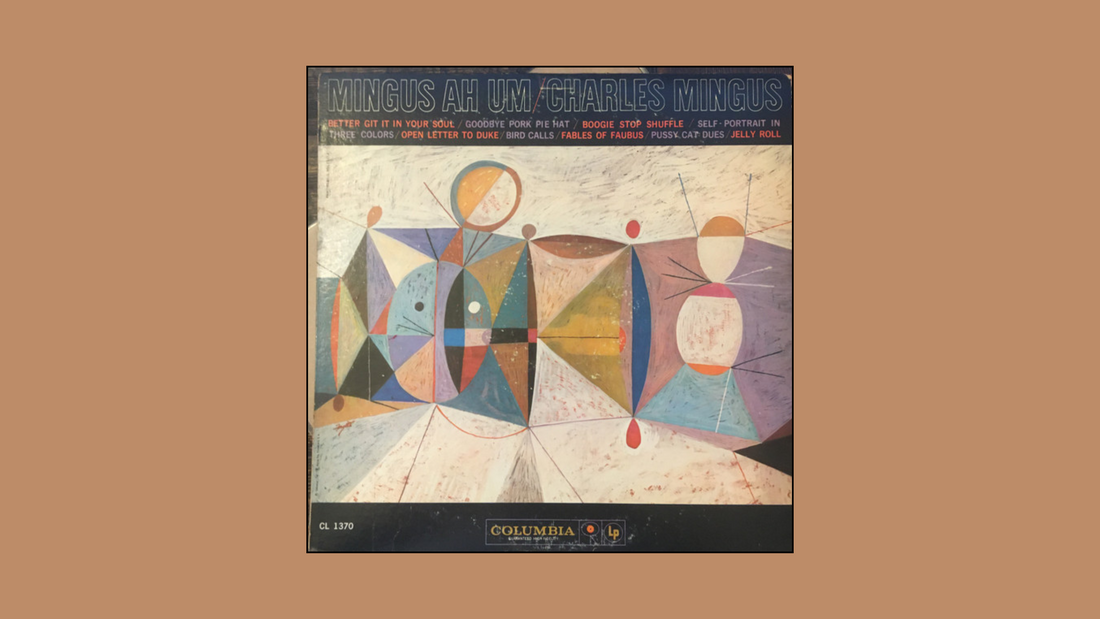
Charles Mingus – Mingus Ah Um (1959)
By Rafi Mercer
The opening seconds of Better Git It in Your Soul erupt like a street parade bursting into the room — handclaps, shouts, a horn section that seems to leap to its feet before the microphone. This is how Charles Mingus begins Mingus Ah Um, with a gospel shout of such urgency that you know at once this is not going to be polite jazz. This is jazz that testifies. Jazz that argues. Jazz that refuses to sit quietly in the corner.
Recorded in 1959, the same miraculous year that produced Kind of Blue, Giant Steps, and Time Out, Mingus’s record feels both part of that era and completely apart from it. Where Davis sought modal clarity, Coltrane harmonic ascent, and Brubeck rhythmic geometry, Mingus pursued something wilder, more contradictory, more human. His music on Mingus Ah Um carries the energy of Ellington’s orchestras, the freedom of bebop, the fire of the church, and the stubborn anger of the blues — all refracted through Mingus’s volatile, restless imagination.
Mingus was as much dramatist as bassist. His compositions rarely settle into one mood; they shift, collide, change course midstream. Mingus Ah Um is a suite of characters, stories, moods. It is as if he set out to capture the full spectrum of Black American life in sound, from prayer to protest, tenderness to rage. The result is one of the most vital and unpredictable albums in jazz.
After the gospel fire of the opener comes Goodbye Pork Pie Hat, a lament written for saxophonist Lester Young, who had died earlier that year. Its melody is mournful but never maudlin, built on long, sighing lines that sound like grief slowly finding its shape. The arrangement, lush yet restrained, shows Mingus’s gift for orchestration — his ability to write parts that feel spontaneous but interlock like clockwork. It is one of the great elegies in jazz, instantly memorable yet infinitely expressive.
Boogie Stop Shuffle flips the mood again, a piece driven by a riff that is at once boogie-woogie, shuffle, and hard bop. The horns snap, the rhythm section pushes forward, the solos dart in and out. It is playful and fierce at once, a reminder that for Mingus, joy and aggression were often inseparable. Self-Portrait in Three Colors slows the pace, a piece of startling beauty with no improvisation at all — a through-composed work that reveals Mingus’s affinity with classical form.
Throughout the album, Mingus wears his influences openly. Open Letter to Duke acknowledges Ellington, Mingus’s greatest model, not through imitation but conversation. It is reverent and irreverent at once, an act of homage that asserts Mingus’s own voice. Fables of Faubus is direct protest, mocking Arkansas governor Orval Faubus for his opposition to school integration. The Columbia release offered only an instrumental version, but even without lyrics the sarcasm and anger are audible. The riffs sneer, the horns jab, the groove refuses to relax. It is satire in sound, proof that Mingus saw jazz as a vehicle for politics as much as for art.
What unites these shifting moods is Mingus himself — his bass not always foregrounded but always central, anchoring the chaos with a physical, muscular tone. His presence is in the writing, in the way the ensemble surges and contracts, in the constant sense that the music might fly apart at any moment only to cohere at the last second. He loved that edge, the brink of collapse. It gave his music a vitality that polite arrangements lacked.
Mingus Ah Um is also notable for its pacing. The album moves like a suite, alternating between frenzy and repose, anger and grace. The sequencing ensures that the listener is never comfortable for long. Just as you settle into one mood, another interrupts. This restlessness is the essence of Mingus’s art: to refuse resolution, to insist that contradictions be heard. Life, after all, does not resolve neatly. Neither does this record.
The band, too, is remarkable. John Handy, Booker Ervin, Shafi Hadi, and others form a reed section capable of both tenderness and bite. Trombonist Jimmy Knepper adds brassy heft. Pianist Horace Parlan provides grounding chords and angular solos. They play Mingus’s mercurial charts with both discipline and abandon, proof of his ability to inspire loyalty even as he terrified his sidemen with outbursts and demands.
To listen to Mingus Ah Um today is to be reminded of how expansive jazz can be. It is an album that contains multitudes — gospel, blues, swing, modernism, protest — without diluting any of them. It is at once deeply rooted in tradition and fiercely forward-looking. It insists that jazz is not one thing but many, and that its vitality lies in that multiplicity.
What keeps the record alive after more than sixty years is its refusal to become background. Put it on and the room changes. The energy of Better Git It in Your Soul is contagious; the sadness of Goodbye Pork Pie Hat settles into the air like dusk. The album does not play politely in the background; it demands attention, reaction, involvement. It is music that insists on being lived with, not skimmed.
Charles Mingus himself remains one of jazz’s most complex figures — visionary, volatile, tender, furious. Mingus Ah Um may be his most approachable album, but it is not simple. It is a mirror of Mingus himself: contradictory, passionate, larger than life. It is a record that argues, seduces, provokes, mourns, and celebrates — sometimes all in the space of a single track.
Listening to it now, you hear not only the sound of 1959 but the sound of timeless human struggle and joy. It is one of those records that feels permanently present, not locked in its era but continually renewed each time the needle drops. Mingus wanted his music to live, to breathe, to fight. On Mingus Ah Um, it still does.


