
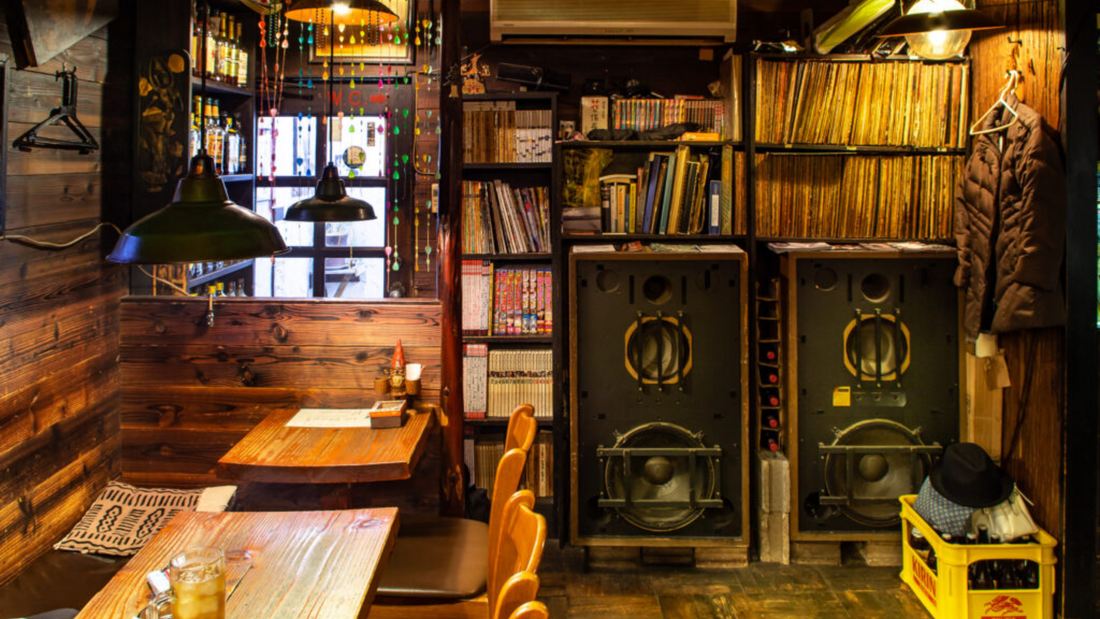
Rag Time — Chitose-Karasuyama’s Hidden Groove
By Rafi Mercer
New Listing
Venue Name: Rag Time
Address: 1-30-10 Minamikarasuyama, Setagaya-ku, Tokyo 157-0062, Japan.
Website: https://ragtime1978.wixsite.com/jazz
Instagram: —
Phone: —
Spotify Profile: —
Tokyo’s centre dazzles with neon, but the city’s true listening culture often hides in the suburbs, where pace is slower and rooms can afford to breathe. Chitose-Karasuyama, a neighbourhood along the Keio Line west of Shinjuku, holds one such treasure. Rag Time has been here since the late 1970s, a jazz kissa that still feels anchored in that era. Walk down its quiet street and you notice the small sign, the door that looks like it could belong to any neighbourhood café. Step inside, though, and you are met with something else entirely: a room where sound has been considered for decades, where listening has been tuned into ritual.
The first impression is the speakers. Old JBL cabinets dominate the space, not as décor but as working instruments. They have lived years of jazz through them, the cones worn to sweetness, the highs softened, the bass thickened into warmth. The collection behind the counter runs to thousands of records, mostly jazz, with a lean into hard bop, swing, and cool — though the owner’s hand ensures surprises appear with regularity. Unlike the curated precision of newer listening bars, Rag Time operates with the looseness of a true kissa. Records are chosen for feel, not fashion, and that freedom gives the room a human texture.
The atmosphere is unhurried. In the afternoons, students and locals sip coffee while saxophone solos curl around the walls. In the evenings, whisky and beer arrive quietly, poured without flourish, as if to remind you that the point here is listening. The lighting stays low, enough to catch the sleeve art, not enough to distract. You notice how people settle into their seats differently than in the city centre; they lean back, they close eyes, they let whole sides play through. The bar has seen four decades of this, and the walls seem to have absorbed the patience.
Rag Time matters because it shows the continuum. Where new listening bars in Tokyo polish the concept into lifestyle, here you feel the roots — the 1970s idea that fidelity could be an everyday part of life, that suburban streets could hold sanctuaries of sound. The room may not look like much at first glance, but it teaches you what it means to listen: that the crackle of a worn pressing, the echo of a trumpet through vintage wood cabinets, the quiet of a stranger nodding along — all of it belongs. This is listening as ordinary miracle, made extraordinary by the care with which it has been preserved.
Step back outside into Setagaya’s night, and you realise the paradox: in a city known for noise and constant reinvention, some of the deepest listening happens here, in a modest room that has barely changed in forty years. Rag Time is not a trend; it is an anchor. For those who care about the geometry of sound, it is one of Tokyo’s indispensable stops.
Rafi Mercer writes about the spaces where music matters. For more stories from Tracks & Tales, subscribe, or click here to read more.


