
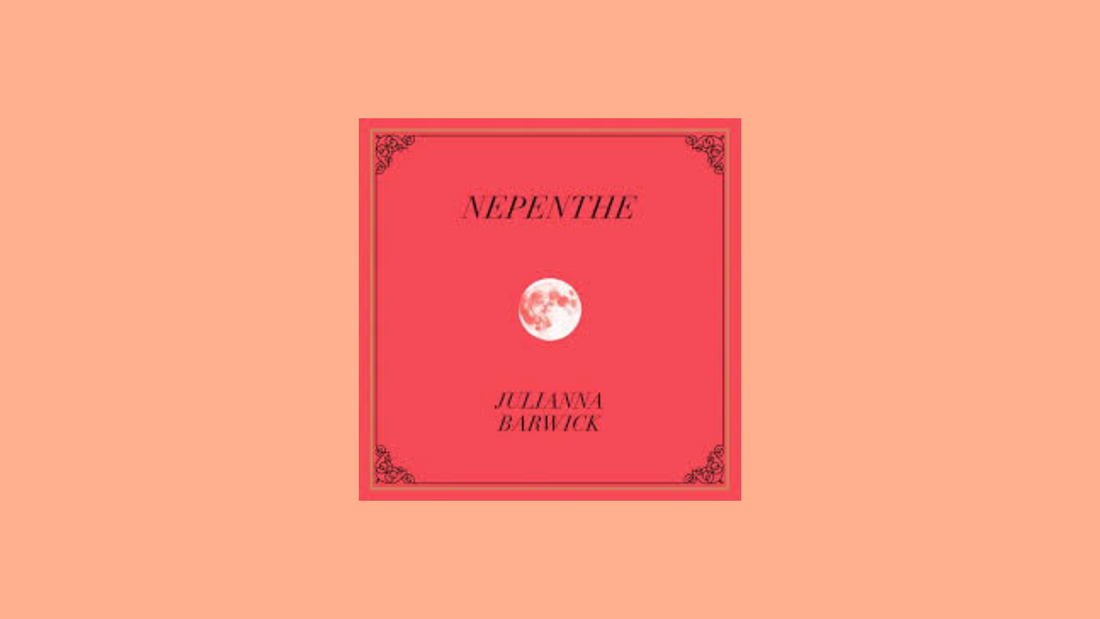
Julianna Barwick – Nepenthe (2013)
By Rafi Mercer
A single voice drifts into the air, layered with delay until it becomes many voices at once — a choir rising out of a single throat. There are no words, only syllables stretched into pure sound. Harmonies bloom like light through stained glass, suspended, luminous, infinite. This is Julianna Barwick’s Nepenthe, released in 2013, a record of wordless devotion and radiant atmosphere. To listen is to enter a cathedral built not of stone, but of breath.
Barwick, raised in Louisiana and steeped in the choral traditions of church singing, found her voice not through lyrics but through loops. Using pedals and processors, she multiplies her vocals into vast architectures of harmony. By the time of Nepenthe — her third full-length album — she had refined that approach into something at once intimate and monumental. The album was recorded in Reykjavík, Iceland, with producer Alex Somers (long-time collaborator of Sigur Rós), and the location is audible in every note: glacial, spacious, elemental.
The opening track, “Offing,” begins with distant voices, like a choir heard across water. Slowly, textures build — vocal layers, subtle piano, faint strings. It feels less like a song than an invocation. “The Harbinger” follows, its harmonies rising and falling in waves, delicate yet immense. “One Half,” the closest thing to a single, introduces actual lyrics — “I guess I was asleep…” — but even here the words dissolve quickly into sound, meaning secondary to texture.
“Look Into Your Own Mind” and “Crystal Lake” extend the atmosphere, voices looping endlessly, strings gliding in the background, rhythms implied rather than stated. The title track, “Nepenthe,” is almost unbearably beautiful, harmonies suspended in stillness, as if time itself has paused. The album closes with “Waving to You,” a short, intimate piece that feels like farewell — a single candle flickering after the cathedral lights fade.
What makes Nepenthe extraordinary is its focus on voice as instrument, not as carrier of narrative but as generator of space. Barwick removes the ego of lyrics, the assertion of personality, and offers instead pure presence. Her sound is generous, inclusive, and deeply hospitable. Anyone can step into it. Women and men, seasoned listeners or newcomers, those who know the choral tradition or those who do not — all find themselves enveloped. It is music that holds rather than instructs.
The cultural context is telling. Released in an era of constant noise and distraction, Nepenthe offered radical stillness. It drew comparisons to ambient pioneers like Brian Eno and to Icelandic dreamscapes like Sigur Rós, yet its voice was uniquely Barwick’s. Critics hailed it as devotional, sacred, healing. It was not tied to any religion, but it evoked the spiritual through sheer sound.
On vinyl, the record is sublime. The surface crackle blends with the airy textures, the warmth amplifies the resonance of voices, the physical act of turning sides mirrors the music’s patience. The cover art, abstract and luminous, captures the sense of drifting light. To lower the needle is to open a space: your room becomes chapel, your listening becomes ritual.
What endures about Nepenthe is its humanity. For all its grandeur, it is never remote. You hear the breath in Barwick’s voice, the fragility behind the layers, the human at the core of the cathedral. It is monumental, but it is also tender. It shows that music can be both vast and intimate, cosmic and personal, a reminder that slowness and presence are acts of care.
To play it today is to step into that care. The voices rise, the harmonies glow, the space expands. You breathe differently. You feel held. And you realise that sometimes the most radical act of listening is not analysis or critique, but surrender.
Rafi Mercer writes about the spaces where music matters. For more stories from Tracks & Tales, subscribe, or click here to read more.


