
The Story Behind the Label
Rafi Mercer reflects on the artistry of record labels — from Blue Note to Factory
By Rafi Mercer
There’s something about the centre of a record — that circular label — that still feels like a secret handshake. Before the first note hits, before the stylus catches the groove, it’s already whispering something. A colour, a typeface, a promise. Those tiny discs of design are, in their own way, the fingerprints of music history. Blue Note. Impulse!. Verve. Island. Factory. Each one says: you’re in safe hands; we know what sound feels like.
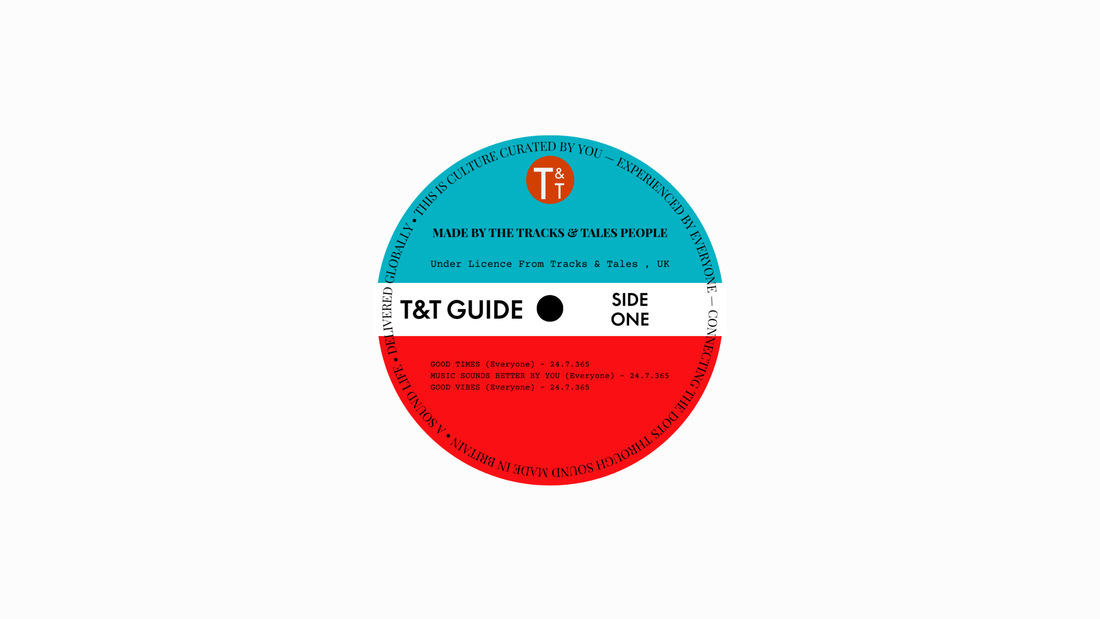
I’ve been sketching my own version lately — a Tracks & Tales label. A simple circle in red, white, and blue, stamped Made by the Tracks & Tales people. It started as a design exercise, but quickly became a thought experiment. What if every record we write about had its own label story too? What if, like a distiller’s mark on a bottle, it told you something about where the music came from, who handled it, and how it was meant to make you feel?
Record labels have always done that, even when they didn’t mean to. Some were like cartographers, mapping whole worlds of sound. You could tell what was inside just by looking. Blue Note’s deep blue and white meant jazz precision — clean, modern, New York cool. Factory’s minimalist codes were Manchester’s echo chamber: numbers not names, grey skies, and brutalist faith. Island’s palm tree was warmth, optimism, a record that smelt faintly of the Caribbean even when played in Birmingham rain. These weren’t just businesses; they were taste systems, portals. You didn’t need to know the artist to trust the label.
The T&T Guide label — if I can call it that — borrows that thinking. It’s a mark of connection more than commerce. A reminder that music, when made and shared properly, has lineage. Each label tells you who made it, who believed in it, and why it mattered enough to press into vinyl. I wrote on the mock-up: Good Times (Everyone) – 24.7.365. Maybe that’s the message. That good sound is always in circulation. That it’s ours, collectively, to play, preserve, and pass on.
When I hold a record, I always flip it over, feel the edge, study the label. It’s a small ritual. It tells me what era I’m about to enter. Some labels have a weight — that thick cardboard, those deep inks — that make the music feel more deliberate. They were printed to last, not to scroll. A record label is a contract of trust: we made this for you to listen, not consume. Somewhere along the line, digital stripped that away. But perhaps, in the culture of listening bars and slow sound, the label is finding its way back.
I sometimes think of Tracks & Tales as a kind of label, really. We don’t press vinyl (not yet), but we press ideas. We collect sounds, stories, and experiences that hold together as a catalogue. One day, there might be actual releases — collaborations between bars, artists, and listeners. Imagine a 12-inch from Studio Mule, mastered in Tokyo, mixed in Lisbon, and launched under a red-and-blue T&T mark. Music that carries the same care and craftsmanship as the bars we write about.
There’s poetry in that thought — every listening bar with its own edition, every record sleeve a small geography of connection. That’s how labels once worked: not just as manufacturers, but as curators of belonging. People bought the label before they knew the track. Maybe that’s the energy we need again — where quality is a signature, not a slogan.
So yes, Rafi Mercer, record label designer — who knew? It started as a sketch, but it reminded me that the centre of every record carries the story of how it was made and who made it for. It’s the soul stamp of the music world. And maybe, just maybe, Tracks & Tales deserves one too.
Rafi Mercer writes about the spaces where music matters. For more stories from Tracks & Tales, subscribe, or click here to read more.


